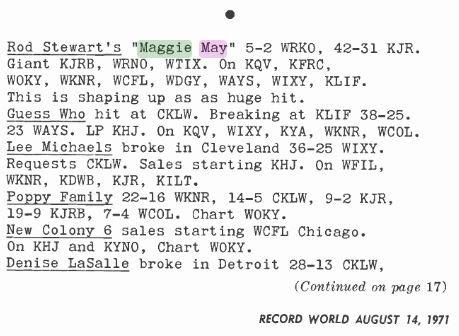
I have to admit that I'm quite surprised by the amount of "Maggie May" mail that continues to come in ... I would NEVER had guessed we could have struck such a nerve with this one!
That being said, today's our last day of "Maggie" Headline coverage ... we'll continue to run your comments and contributions ... but only as part of our regularly scheduled comments pages.
Meanwhile, we CANNOT ignore all the interesting tidbits our readers have turned up on this topic ... so today's posting goes out with a major Thank You for all of you on the list have continued on with your own research.
The truth is, we are NEVER going to come up with a definitive answer on this ... those kinds of records simply aren't kept (and even if they ever did, they don't exist anymore.) Pop music has always been "of the moment" ... so while it's clear that disc jockeys all over the country jumped on this track and forecast its hit potential, to definitively single out any one radio station or any one disc jockey as being the first to flip the record over simply cannot be done ... especially since it now looks like a number of these stations had already been playing the track as an album cut ... and some even charting it that way.
Still ... we want to share with you the latest and greatest from our very astute readers ...
Hi Kent,
I'm sending you a couple
of radio station charts that clearly show "Maggie May" at or near the
top of the charts in July 1971. Keep in mind that stations could've been
playing the song as an album cut. Rod's "Every Picture Tells A
Story" debuted on Billboard's LP chart on June 19, 1971, which means it
was actually released at least a couple weeks prior to that. I've been
reading some reviews of the album from 1971 and several of them mention
"Maggie May" as the stand-out cut from the album.
No matter who actually
played it first, there's no denying that history has proven them right.
It's always been one of my favorite Rod Stewart songs, although I agree that
classic rock radio has burned it to a crisp over the years.
Paul Haney
Record Research
Well, there you have it … the actual
KRLA chart with “Maggie May” at #4 on July 6th. And how about the WMEX chart … “Maggie May”
at #1 and “Reason To Believe” charting separately at #2!!! And both showing as having already charted
for five weeks, which now pushes this to late June.
It all seems pretty definitive to
me. WLS first charted “Maggie May” on
August 30th.
The only thing we CAN’T account for
is when WMMS in Cleveland first charted it … but I’m thinking that perhaps they
DIDN’T … additional research makes WMMS look like it was already an FM “underground”
station by this point … and likely wasn’t publishing Top 40 Charts … so we may
never know their airdate for sure. (A WOKY Chart would also be helpful if somebody can come up with one.)
But using Paul Haney’s information above,
if the album came out in early June, stations COULD have been playing “Maggie
May” as an album track, I suppose … but then I would think that this would have
influenced Mercury’s decision as to which side to push. Consider this … “Maggie May” was already #4
on July 6th … but didn’t chart AT ALL in ANY of the three major
trade publications until August 14th!!! That’s 5-6 weeks later!!! So while the plan may have been for “Reason
To Believe” to be the hit side (it first charted nationally on July 17th
… STILL two weeks after “Maggie May” was already #4 on one of the hottest radio
stations in the country.) Based on THIS information,
I’ve got to award the most likely station to flip the record and make “Maggie
May” a hit HAD to be KRLA. As stated
previously, Chuck Buell convincing KHJ to jump on a record WLS themselves wouldn’t
first chart until August 30th would put KHJ six weeks behind their
biggest competitor, KRLA. (kk)
Kent,
I
just heard back from Mitch Michaels.
WMMS was a free form / progressive FM rock
station. In keeping with the time period, the jocks played whatever the
hell they wanted. There was no set playlist. They probably made up a
sheet of songs to send to record companies, so they would send them
music. I know that's what was done when I worked at WZRD Chicago, (who
just celebrated their 47th anniversary as free form radio.)
At the time,
record companies weren't paying attention to hippie radio stations, so
they got serviced last. Hence the "playlists."
So you gotta think, such a
station would have jumped on Every Picture Tells A Story, right away.
Remember when record stores would open at midnight to sell the latest
"hot" new release? It seems the point of controversy is really not who
was the first to flip the record over. Mitch isn't claiming that. He
just gave Rod his opinion. Now is Rod's memory correct? I don't think
Mitch's recollection is wrong, about the conversation, nor Jay Leno.
Could have Rod gotten the cities mixed up? Possible. We all know how
events sort of blend into one another over time. I think Mitch's story,
as he relates it, is accurate.
Jack
Funnily enough, I had just written a similar analysis for today's posting ... >>>Additional research makes WMMS look
like it was already an FM “underground” station by this point … and likely
wasn’t publishing Top 40 Charts … so we may never know their airdate for sure.
It truly is unreal how this topic keeps going ... I would have NEVER have guessed it would have this kind of legs. (As you can see, we've already got several more new charts to unveil in today's post ... with more commentary as well.)
Mitch
Michaels and Chuck Buell are both sticking with their stories ...
and I feel certain that THIS is the clear memory in each of their minds, although it looks like KRLA was airing "Maggie May" a good 5-6 weeks
earlier than that ... most likely as an album cut. My guess is seeing
"Maggie May" being delegated to the B-Side was enough to inspire BOTH
of these knowledgeable DJ's to tell the record company, "You're promoting the
wrong side of this record." Prior to that, they really wouldn't have
known what, if any, singles plans may have been on their minds. Let's
face it ... Rod's first two solo albums didn't exactly burn up the
charts. Once "Maggie May" hit ... and "Every Picture Tells A Story"
followed it to #1 on the album charts, fans wanted to hear more from
this artist ... so his first two LPs started selling as well. I'm thinking it was likely more a case of each disc jockey thinking, "Well, if you're going to put out a single from this album, don't use THIS one!!! Flip the record over and push "Maggie May" instead ... because THAT'S the one we're getting all of the positive reaction to. (In all fairness, in order to compete with the growing FM radio market, Top 40 stations WERE starting to play more album tracks as part of their programming, just to keep listeners tuned in.) kk
WMMS was a progressive rock station. There would be no top 40 playlist.
ARSA lists one from May, 1971, but it's a repro of some of the album cuts
they were playing.
Jack
Here is yet another chart showing “Maggie May” charting
early. (Please note that I said in my
initial email that some stations played both tracks early on.)
In Baltimore ... by then I had integrated album cuts into
the station's basic Top 40 format ... I never played "Reason To
Believe." We programmed "Maggie May," "Mandolin Wind,"
and "(I Know) I'm Losing You" with “Maggie May” in a heavier rotation
than the other two, which shared airplay with album cuts by other artists.
Ed Osborne
And, according to this WBKO Chart,
both sides of the hit single had already been charting for five weeks, again
placing it to early July (plus any other pre-chart airplay it might have
received.) kk
And ... here is the first appearance of Maggie May / Reason
To Believe on a WLS survey.
BTW: Haven't found relevant surveys for WMMS or WOKY so the
verdict is still out on their part in the Maggie May mystery.
Keep on rockin', Kent!
Ed
Clark Besch did some more digging of
his own on this … and the timeline DEFINITELY starts much earlier than we
thought. (You’ll even find Record World
telling us “If you recall, we were the first to tell you that ‘Maggie May’ was
the hit side as opposed to the original A-Side, ‘Reason To Believe.’” Seems like EVERYBODY had a hand in making this
one a hit!!!
A little more digging gives little help. You may have seen
"Maggie May" just dipping to #3 from #1 in my 1971 surveys of KLZ-FM
Denver a few days ago. You can see below that they were likely one of the
very early stations on Maggie May in July, 1971.
A host of stations are on the song by August 4, 1971 according
to Record World
Kal Rudman's column
same week, claiming many stations are playing it as an LP cut still.
[A distinct possibility as to how it
could have charted this early on some stations … but proof again that it was
already common knowledge in the industry that THIS was the hit side of the
record. – kk]
Chicago is home of the top label in their issue dated 10-9
1971!!!
And here, Kal takes full credit AFTER he reports stations played
the song??? This is from the 12-11-1971 issue
of Record World.
For an interview of
"to the point" questioning worthy of Kent Kotal, scroll down to page
39 on this page for a good Rod Stewart article / interview from 6-27-1986 that
ran in The Gavin Report!
https://worldradiohistory.com/Archive-All-Music/Gavin-Report/80/86/Gavin-1986-06-27.pdf
Good stuff in Forgotten Hits
today, Kent!
“The Battle of the ‘Charts,’ ‘Music
Surveys,’ ‘Hit Parades,’ etc.
There was, at times, a lag between
when a song was first played on anyone’s air and when it first charted
on their weekly ‘list.’ So "charting" isn't always the best
barometer of initial airplay. And I was not a "believer" in advancing
a song up a chart prematurely in anticipation of its "hitness."
But if I’d known how iconic “that”
song would become, however, I would have saved its lifespan’s weekly Hit
Parade rise and decline. I did not. So, I have nothing there,
admittedly.
Anyway, I stand by my story as I
"remember" it and also recall that I did not know until many years
later the “estimated” number of radio stations who watched our record “adds”
and added some songs to their air because we were playing it. This was
an exciting and interesting time for contemporary music for me then.
And I’m always open to any
clarifications to any of my stories as long as they are respectfully expressed,
factually supportive and without snarky comments.
So, in closing, this little-known
quote ~~~
“Chuck Buell was always my
Favorite Disk Jockey!” - Maggie May - circa 1971
CB
Hi Kent,
Some additional information on Maggie May ...
It was co-written by Rod and Martin Quinteton, a bass player from a band called Steamhammer.
It was an afterthought and last track suggested for the album “Every Picture Tells A Story.”
It included the mandolin part played by session musician Ray Jackson from the band Lindisfarne.
Ray got paid a session fee of £ 15 ...
Rod gets £250k per year every year in royalties for the writing of the song.
Martin was asked to join The Faces and refused due to the band's wild antics. He died in 2015, after leading a very shy life.
He also co wrote "You Wear It Well."
Regards -
Geoff Dorsett
By all accounts, it seems "Maggie May" was added to Rod Stewart's "Every Picture Tells A Story" as more of an afterthought ... they had only recorded nine tracks and needed one more so the producer asked, "What else have you got?"
Again, I stick by my theory that all of the principles involved thought so little of the track at the time that they stuck it on the B-Side of the first single, simply as a means to burn it off. (Nearly everyone told Rod it was too long to be a hit single.)
As for Ray Jackson, my understanding is that he was there at the studio that day to put his mandolin on the track "Mandolin Wind," another song from the album. Since there was time left over and he was there anyway, they decided to see what "Maggie May" would sound like with a mandolin on it ... so yet another fortunate, happy circumstance. It is also believed to be the first #1 Rock Song to ever feature the instrument. (kk)
As someone mentioned the Rod Stewart concert at the Syndrome on your page, here is a story I wrote for the Illinois Rock & Roll Music Archives on the Coliseum / Syndrome.
Chicago Coliseum
As rock concerts blossomed in the late ‘60s, with a
capacity of 12,000, the Coliseum (1513 S. Wabash) provided a space larger than
concert venues such as the Auditorium Theater, Civic Opera House and Arie Crown
Theater. Although the building was an acoustically challenged barn that was in
serious need of repair in a less than ideal neighborhood on the near South Side
of Chicago, it provided a perfect place for rock crowds who could have cared
less about the condition or location of the facility. From 1968 - 71, the
Coliseum became the major Chicago concert venue.
For those who remember the stone
façade, it was originally built in the 1880s to surround a Civil War museum
constructed by candy magnate Charles Gunther. The façade was a re-creation of
the Confederate Libby Prison, which was brought to Chicago from Richmond,
Virginia, and re-assembled brick-by-brick on the site. In the early 1900s it
was the premiere indoor arena, and was actually a model for future arena
designs. The venue hosted six national political conventions and was the
original home for the Chicago Blackhawks.
Following the Depression Era,
the revitalization of Chicago saw the Chicago Stadium open in 1929 and the
International Amphitheater in 1935. The Coliseum quickly became antiquated and
too small, relegated to second tier events. By World War II, the venue became a
training facility for American troops.
After the war, both the Coliseum
and the neighborhood it was in deteriorated in major disrepair. Still, the size
of the venue continued to make it viable even if only for events such as roller
derby, professional wrestling, and evangelical revival meetings.
Venues being used at the time
including the Civic Opera House and Auditorium held less than 4,000, and the
popularity of rock forced promoters to seek a larger venue. And the Coliseum
fit the bill. The concerts were general admission with folding chairs on the
main floor.
Triangle Productions was one of
the main promoters at the time and brought in acts like The Doors (here’s audio
of their Mary 10, 1968, performance: https://youtu.be/qYoCynZHl9E).
1968 also saw the likes of Cream, Jimi Hendrix, and the Rascals play there;
with future concerts featuring the Grateful Dead, Alice Cooper, et al.
One of the promoters who went
into the venue was Dick Gasson of 22nd Century Productions. In 1970,
he re-branded the building as The Syndrome when his plans to reopen the Kinetic
Playground did not materialize. The first show was on October 16, 1970, with
Grand Funk Railroad, Humble Pie and Chase. As the Syndrome, it only lasted six
months. The last show was James Taylor and Carole King on March 12, 1971. A day
later, the City of Chicago shut the building down citing health and fire code
violations. Concerts then moved to the International Amphitheater.
The
site is now occupied by the Soka Gakkai USA Culture Center. The commemorative
Coliseum Park is located across Wabash Avenue from the original venue site.
Coliseum Concerts:
April 27, 1968 Cream
& Mothers of Invention
May 10, 1968 The
Doors & One-Eyed Jacks & Shady Daze
Sept. 28, 1968 The
Rascals
Oct. 13, 1968 Cream
& Conqueror Worm
Nov. 3, 1968 The
Doors
Dec. 1, 1968 Jimi
Hendrix Experience & Soft Machine
Jan. 23, 1970 Grateful
Dead
May 16, 1970 B.B.
King
Nov. 27, 1970 Grateful
Dead
Dec. 31, 1970 The
Byrds & Alice Cooper
Mar. 19, 1971 New
Riders of the Purple Sage & Grateful Dead
Syndrome Concerts:
Oct. 16, 1970 Grand
Funk Railroad, Humble Pie, The Brethren, Chase
Nov. 6, 1970 Traffic,
Siegel-Schwall Band, Mott the Hoople, Conqueror Worm
Nov. 13, 1970 Small
Faces with Rod Stewart, Elvin Bishop, Haystack Balboa, Soup
Nov. 20, 1970 Ten
Years After, Mylon, Skid Row, Quatermass
Nov. 27, 1970 Grateful
Dead, New Riders of the Purple Sage
Jan. 20, 1971 Free,
Siegel-Schwall Band, Hammer
Feb. 20, 1971 Mountain,
Fleetwood Mac, Ned
Mar. 5, 1971 Steppenwolf,
Flash
Mar. 12, 1971 James
Taylor, Carole King, Jo Mama
As the Syndrome was closed effective March 13, other
shows that were scheduled had included:
Mar. 19, 1971 Grateful
Dead, New Riders of the Purple Sage (cancelled)
Mar. 20, 1971 Black
Sabbath, J. Geils Band, Dreams (cancelled)
Mar. 26, 1971 Johnny
Winter, Allman Brothers (cancelled)
Apr. 2, 1971 Jethro
Tull, Brethren, McKendree Spring (cancelled – moved to Opera House)
Apr. 9, 1971 James
Gang, Spencer Davis & Peter Jameson (cancelled – moved to Opera
House 4/10/71)
Apr. 23, 1971 Moody
Blues, Trapeze (cancelled)
May 1-2, 1971 Grand
Funk Railroad (cancelled – moved to International Amphitheater)
May 28 1971 Frank
Zappa & The Mothers of Invention (cancelled – moved to Auditorium)
Ken Voss
https://www.facebook.com/groups/870729336712789
Rod Stewart's MAGGIE MAE it made its debut on
our local survey for the week of August 26, 1971, where, for the week of
September 23, it would peak at #1 and would remain at #1 for 5 weeks. I
noticed that when it fell off the #1 position down to #2, it was
listed with the flip REASON TO BELIEVE also listed. Going up to
song position #1, just MAGGIE MAE was listed on the survey. The week of
December 2 was the last time it was listed on the survey before it fell
off and again, going down, the flip REASON TO BELIEVE was also listed ... but
never going up the survey. Search me!
FYI, Cher knocked him off the #1 spot.
Larry Neal