The Forgotten Hits Billy Joe Royal lovefest continues today with this excellent piece provided by Jeff March and Marti Smiley Childs ...
It comes from their book "Where Have All The Pop Stars Gone, Volume 3," available for purchase via the link provided below. (kk)
Insights into … Billy Joe Royal
[9 Billboard Hot 100 singles, 1965–78; plus 14
country music charted singles]
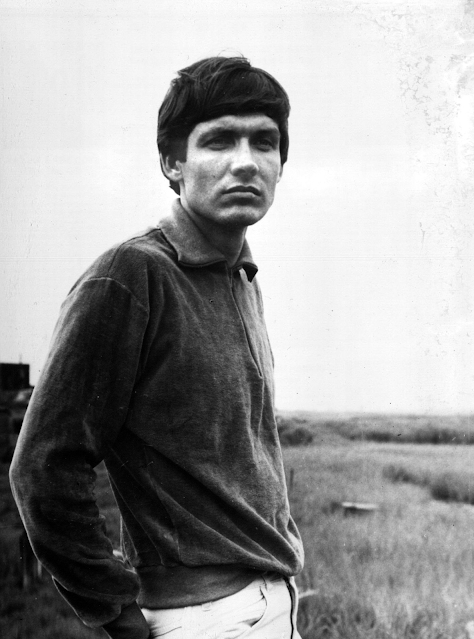
Billy Joe Royal in an outtake from the 1965 photo session
for the cover of his Down
in the Boondocks album
(photo courtesy of Savannah Royal)
Picture the
1955-era town square in the original Back
to the Future movie, with a
butcher shop, a bakery, a malt shop, a shoe store, a dress shop, a hardware
store, and other mom-and-pop shops surrounding the central green. That was
Billy Joe Royal’s memory of Marietta, Georgia, where in the ’50s he spent much
of his childhood and adolescence. “We had two movie theaters on the square, and
when the movie let out, we all hung out at the drugstore,” Billy Joe recalled.
Marietta Square also had a bandstand and a gazebo. He and his family had moved
from his birthplace, Valdosta, Georgia, to Marietta in 1952 when he was 10
years old.
Billy Joe
Royal – that was his true birth name – was the oldest among his three other
siblings – his brother, Jack, two years younger, and two sisters, Marilyn and
Christine. Their parents, Clarence and Mary, worked hard to scrape together a
living for the family. They picked cotton, then moved to a mill village and
worked at the cotton mill, and Billy Joe’s dad supplemented that with work as a
construction laborer whenever he could. The Royal family lived the life of
poverty that Billy Joe described with such feeling in his 1965 breakout hit, “Down
in the Boondocks.”
Billy Joe, who as an adolescent enjoyed country, pop,
and gospel music, had planned to become a lap steel guitar player. But after
gaining experience singing with local bands, he passed a singing audition at
age 14 to appear on the Georgia Jubilee, a barn-dance program that was
broadcast on Atlanta-area radio. Also chosen that day was country music singer
Freddy Weller, and fellow performers that Billy Joe met there included Jerry
Reed, Ray Stevens, Tommy Roe and – most importantly for him – Joe South (birth
name: Joseph Souter). Royal and South connected with Atlanta recording studio owner
and music publisher Bill Lowery, for whom Billy Joe began recording demos in
1961. Lowery built his northeastern Atlanta studio in the abandoned Brookhaven
School building that he had purchased. The property included an old, empty
septic tank – which, as it turned out, had remarkable acoustic properties. With
audio fed into the drained, dry tank, it served as a fine echo chamber.
Various labels released Billy Joe Royal singles but
success eluded him until 1965, when Lowery persuaded Columbia Records to
release Billy Joe’s recording of Joe South’s composition “Down in the
Boondocks.” That sent him into the top 10, and he followed it with his
interpretation of two other Joe South songs: “I Knew You When” and “I’ve Got To
Be Somebody.”
Billy Joe’s releases during the following couple of
years sputtered, but lightning struck again at the end of the decade. After Joe
South signed with Capitol Records as a recording artist in late 1967, Columbia
paired Billy Joe with arranger Emory Gordy Jr. and producer Buddy Buie,
architect of the Atlanta Rhythm Section (ARS) and a longtime associate of Bill
Lowery’s. ARS drummer Robert Nix and Billy Gilmore had written a song inspired
by a place in New Jersey. Billy Joe recorded the song, about a girl who by
daytime had been “a teaser” and at nighttime “a pleaser” – before marrying and
moving away from Cherry Hill, New Jersey – a song in step with that “free love”
era. In the autumn of 1969, Billy Joe’s recording of “Cherry Hill Park” cracked
the top 40 and ultimately landed at No. 15, remaining on the chart for 15
weeks.
Billy Joe’s pop music career entered another slump in
the 1970s, and for a dozen years he worked primarily as a lounge entertainer in
Nevada casino cabarets. The shift of his friend Kenny Rogers from pop to
country inspired Billy Joe to reach back to his own country roots. By 1985,
Billy Joe re-emerged as a persistent hit-making country music artist on the
strength of a top-10 single, “Burned Like a Rocket.” He continued making
country music chart appearances into the early 1990s. By then, he had been
sought as a performer on oldies shows. In the autumn of 2015 he was on tour. Four
days before one of his scheduled performances, fans were stunned to learn that
he had died unexpectedly in his sleep on October 6, 2015. He was 73 years old.
Billy Joe Royal left a rich musical legacy for pop
and country music fans, recognized by his 1988 induction into the Georgia Music
Hall of Fame.
Billy Joe Royal recorded from 1985 to 1992
for the Atlantic America country
music label,
which issued this publicity photo of him
Billy Joe’s first steel guitar, which he had seen in a store
window
“I didn’t want to ask my folks for it because I knew
it cost too much, but that was what I really, really wanted. We were all as
poor as we could be. I was 12 years old, and when I came downstairs at
Christmas, my parents said, ‘There’s something hidden behind the tree.’ They
knew how much I wanted a lap steel guitar, and they had bought one for me with
a little amplifier. It only cost $36, but it was a fortune for my parents. I’ll
never forget that feeling. I went crazy.”
The septic tank echo chamber at Bill Lowery’s recording studio
“The septic tank echo chamber worked fine, except for
when it rained. Also, a railroad line ran right by the studio, and every time a
train would come through we would have to stop recording.”
Billy Joe’s admiration of Joe South
“Many people don’t realize that besides being, to me,
the greatest writer that ever lived, Joe South was one of the greatest guitar
players. Joe South was truly a genius. That’s him playing guitar on Aretha
Franklin’s ‘Chain Of Fools’ record. He played with Simon and Garfunkel, and he
played with Bob Dylan too.”
The narrative and quotations in this article are
excerpted from the book Where Have All the Pop
Stars Gone? — Volume 3, by Marti Smiley Childs and Jeff
March. This material is copyrighted © 2016 by EditPros LLC and may not be
reproduced or redistributed without written permission. Book available for purchase here: https://www.editpros.com/WHATPSG_Vol_3.html
Billy Joe Royal also recorded the Joe South songs "Hush" (#52, 1967, and a hit all over again ... albeit in a completely different arrangement ... the following year for heavy metal group Deep Purple) and "Yo Yo" (#117, 1966), which would go on to become a HUGE pop hit (#3) for The Osmonds in 1971. South also penned five other chart hits for Billy Joe, giving him nine charters in all. Royal also charted with hits written by Chip Taylor and Billy Vera, Paul McCartney, Wayne Carson Thompson and Mac Davis ... as well as his buddy Freddy Weller.
He is one of those artists that I never got the chance to see. (I don't think he played Chicago much.) We talked thru Forgotten Hits a couple of times and he seemed to be a genuinely nice man ... VERY appreciative of his fans and the success the bestowed upon him. It was a sad day when Billy Joe Royal died in 2015. (kk)
Billy Joe Royal became a successful country artist nearly overnight once he took the plunge in 1985. (Honestly, it seemed like such a natural step, given Billy Joe's roots. And country music fans are a very loyal audience.)
Fifteen country hits followed, including six Top Ten's. Two of those climbed as high as #2: "Tell It Like It Is" (1989) and "Till I Can't Take It Anymore" (1990)
Here's my favorite Billy Joe Royal country tune ...
"I'll Pin A Note On Your Pillow," #5, 1988
The narrative and quotations in this article are
excerpted from the book Where Have All the Pop
Stars Gone? — Volume 3, by Marti Smiley Childs and Jeff
March. This material is copyrighted © 2016 by EditPros LLC and may not be
reproduced or redistributed without written permission.
https://www.editpros.com/WHATPSG_Vol_3.html